In fluid mechanics and thermodynamics, properties like density, specific weight, specific volume, and specific gravity are fundamental to understanding how materials behave under different conditions. These properties are widely used in engineering fields such as mechanical design, hydraulics, aerospace, and process industries. Whether you’re analyzing fluid flow in pipelines, designing hydraulic systems, or selecting materials for construction, these concepts help you quantify how mass, volume, and force interact.
This guide breaks down each property in a simple, practical way so you can clearly understand their meaning, formulas, units, and real-world applications.
1. What is Density?
Definition
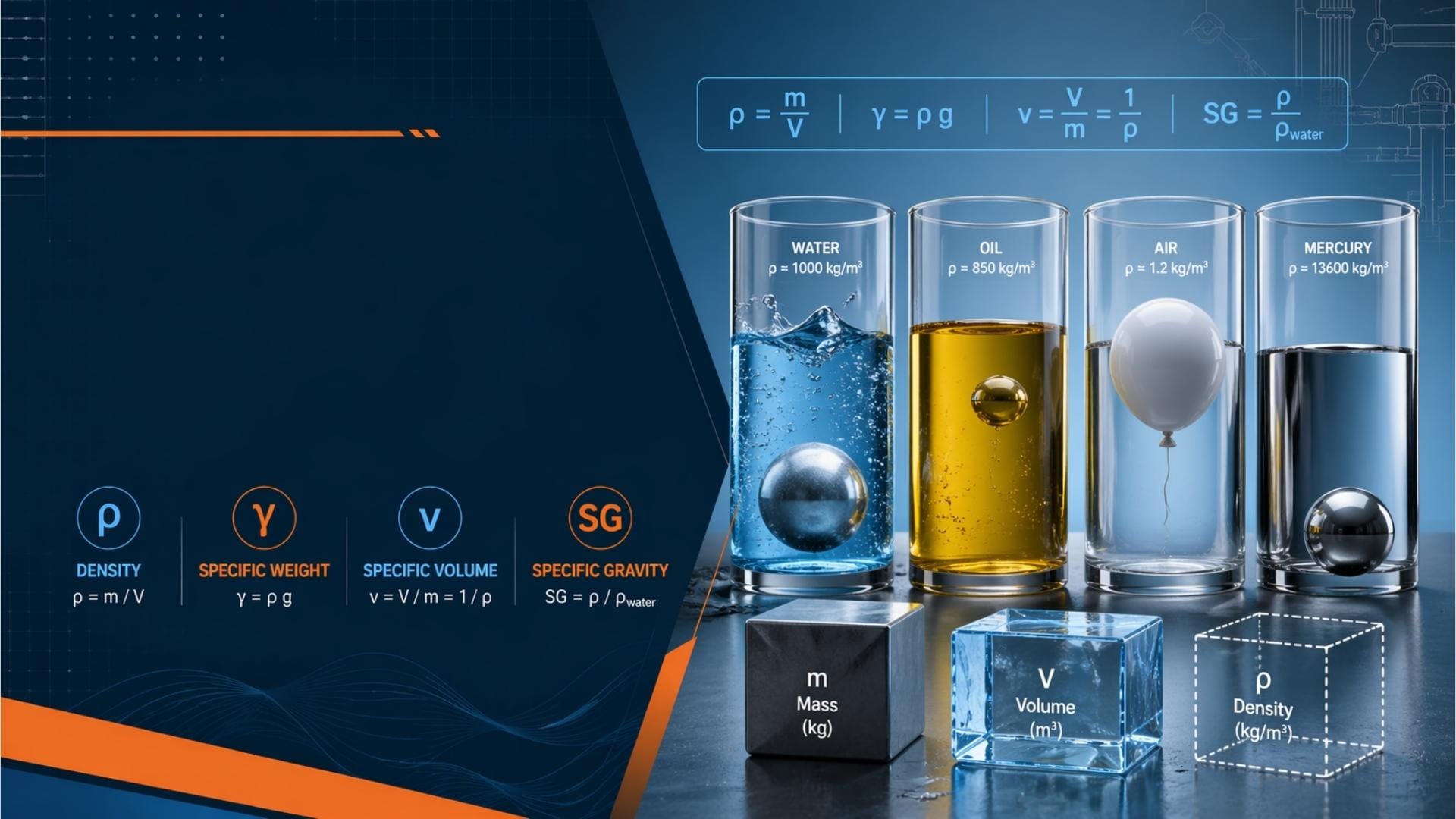
Density is the mass per unit volume of a substance. It tells how tightly matter is packed.
Formula
Density (ρ) = Mass / Volume
SI Unit
kg/m³
Explanation
Higher density means more mass in a smaller volume (e.g., metals)
Lower density means less mass in a larger volume (e.g., gases)
Examples
Water ≈ 1000 kg/m³
Air ≈ 1.225 kg/m³
Practical Applications
Ship design (floating depends on density)
Material selection
Fuel efficiency calculations
2. What is Specific Weight?
Definition
Specific weight is the weight per unit volume of a substance.
Formula
Specific Weight (γ) = Weight / Volume
Since Weight = Mass × Gravity: γ = ρ × g
SI Unit
N/m³
Explanation
It considers gravitational force
Useful in fluid pressure calculations
Example
For water: γ = 1000 × 9.81 = 9810 N/m³
Applications
Hydraulic systems
Pressure calculations in fluids
Dam and reservoir design
3. What is Specific Volume?
Definition
Specific volume is the volume occupied by a unit mass of a substance.
Formula
Specific Volume (v) = Volume / Mass
It is the reciprocal of density: v = 1 / ρ
SI Unit
m³/kg
Explanation
High specific volume → less dense substance
Low specific volume → more dense substance
Example
For water: v = 1 / 1000 = 0.001 m³/kg
Applications
Thermodynamics (steam tables)
Gas behavior analysis
HVAC systems
4. What is Specific Gravity?
Definition
Specific gravity is the ratio of the density of a substance to the density of a reference substance (usually water for liquids).
Formula
Specific Gravity (SG) = Density of substance / Density of water
Unit
No unit (dimensionless)
Explanation
SG > 1 → Substance is heavier than water (sinks)
SG < 1 → Substance is lighter than water (floats)
Examples
Mercury ≈ 13.6
Oil ≈ 0.8
Applications
Fluid identification
Petroleum industry
Chemical processing
5. Key Differences at a Glance
Property
Definition
Formula
Unit
Depends on Gravity
Density
Mass per unit volume
ρ = m/V
kg/m³
No
Specific Weight
Weight per unit volume
γ = ρg
N/m³
Yes
Specific Volume
Volume per unit mass
v = 1/ρ
m³/kg
No
Specific Gravity
Ratio of densities
SG = ρ/ρwater
No unit
No
6. Real-World Understanding
Density tells how compact a material is
Specific weight tells how heavy it feels under gravity
Specific volume tells how much space one kg occupies
Specific gravity compares substances easily without units
7. Practical Engineering Applications
Mechanical Engineering
Engine fluid selection
Lubrication systems
Civil Engineering
Soil analysis
Concrete design
Chemical Engineering
Fluid mixing
Reaction design
Aerospace
Fuel calculations
Air density effects
8. Common Mistakes to Avoid
Confusing density with specific weight
Ignoring gravity in specific weight calculations
Using wrong reference in specific gravity
Forgetting that specific volume is inverse of density
Conclusion
Density, specific weight, specific volume, and specific gravity are closely related properties that form the backbone of fluid mechanics and thermodynamics. Each serves a unique purpose—from measuring compactness to comparing substances and analyzing fluid forces. Understanding how they differ and where they apply helps engineers make accurate calculations and better design decisions.
Mastering these concepts not only strengthens your fundamentals but also improves your ability to solve real-world engineering problems. To deepen your understanding, explore related topics like pressure, buoyancy, and fluid statics.