Pumps are one of the most essential mechanical devices used across industries and daily life. Simply put, a pump moves fluids (liquids or gases) from one place to another by converting mechanical energy into hydraulic energy. Whether it’s lifting water from a well, circulating coolant in engines, or delivering fuel in automobiles, pumps play a critical role in modern systems.
They can be powered by electricity, engines, or even manual effort, and are available in sizes ranging from tiny biomedical pumps to massive industrial units. Understanding how pumps work and their different types helps engineers and technicians select the right pump for specific applications, ensuring efficiency, durability, and performance.
What is a Pump?
A pump is a mechanical device that transfers fluid from a lower level to a higher level or from one location to another by increasing its pressure or velocity.
Key Functions of a Pump:
Move fluid from one place to another
Increase pressure of fluid
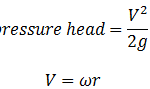
Overcome height differences (head)
Maintain flow in systems
Main Types of Pumps
Pumps are broadly classified into two main categories:
Positive Displacement Pumps
Centrifugal Pumps (Dynamic Pumps)
1. Positive Displacement Pumps
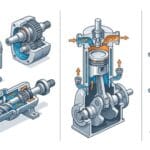
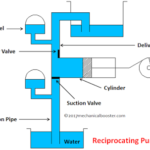
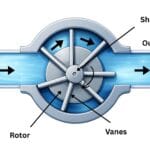
A positive displacement pump moves fluid by trapping a fixed amount and forcing it into the discharge pipe.
These pumps use pressure generated by trapped gas (usually air).
Examples:
Hydraulic ram pump
Airlift pump
2. Velocity Pumps
These pumps increase fluid velocity and convert it into pressure.
Example:
Centrifugal pump
3. Gravity Pumps
Fluid flow occurs due to gravitational force.
Examples:
Siphon
Heron’s fountain
4. Valveless Pumps
Operate without valves and rely on fluid dynamics.
Example:
Impedance pump
Classification Based on Flow Direction
1. Axial Flow Pumps
Fluid flows parallel to shaft
Used for high flow, low head
2. Radial Flow Pumps
Fluid flows perpendicular to shaft
Used for high head
3. Mixed Flow Pumps
Combination of axial and radial flow
Balanced performance
Real-World Applications of Pumps
Pumps are used in almost every industry and daily application:
Water supply from wells and tanks
Irrigation systems in agriculture
Fuel injection in engines
Cooling systems in power plants
Chemical and oil industries
Wastewater treatment plants
Advantages of Pumps
Efficient fluid transport
Wide range of applications
Available in various sizes and capacities
Easy integration into systems
Limitations of Pumps
Energy consumption
Maintenance requirements
Cavitation issues (in some pumps)
Wear and tear over time
Conclusion
Pumps are indispensable devices that enable fluid movement in countless engineering and real-world applications. From simple water lifting systems to complex industrial processes, their role is fundamental to efficiency and functionality. Understanding the different types of pumps, their working principles, and their applications helps in selecting the right pump for any system. As technology advances, pumps continue to evolve, becoming more efficient, reliable, and adaptable to modern engineering needs. Exploring related topics like turbines, compressors, and fluid mechanics can further deepen your understanding of fluid systems.