Fluid mechanics becomes truly useful only when you understand the properties of fluids. These properties explain how liquids and gases behave under different conditions such as pressure, temperature, and motion. Whether you’re designing pipelines, hydraulic systems, lubrication systems, or aerodynamic components, fluid properties directly influence performance, efficiency, and safety.
In real-world engineering applications, from automobile braking systems to aircraft aerodynamics—fluid behavior determines outcomes. Understanding these properties helps engineers predict flow patterns, calculate forces, and optimize systems. This guide provides a clear, practical, and in-depth explanation of all major fluid properties, making it easier to connect theory with real-world engineering use.
What Are Fluid Properties?
Fluid properties are the characteristics that define how a fluid behaves when subjected to forces, temperature changes, and motion. These properties determine how fluids flow, resist deformation, and interact with surfaces.
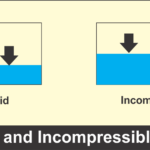
Compressibility is the ability of a fluid to change its volume under pressure.
Key Points
Liquids → Slightly compressible
Gases → Highly compressible
Engineering Importance
Crucial in gas dynamics and aerodynamics
Affects sound propagation in fluids
6. Surface Tension
Definition
Surface tension is the force acting on the surface of a liquid that causes it to behave like a stretched membrane.
Key Points
Unit: N/m
Caused by molecular attraction
Higher in liquids than gases
Practical Example
Water droplets forming spherical shapes.
7. Capillarity
Definition
Capillarity is the rise or fall of liquid in a small tube due to surface tension.
Key Points
Caused by adhesive and cohesive forces
Important in small-scale fluid systems
Practical Example
Ink rising in a pen or water moving in plant roots.
8. Vapor Pressure
Definition
Vapor pressure is the pressure exerted by vapor in equilibrium with its liquid.
Key Points
Increases with temperature
Important for boiling and cavitation
Engineering Importance
Helps avoid cavitation in pumps
9. Cohesion and Adhesion
Cohesion
Attraction between same molecules
Adhesion
Attraction between different molecules
Example
Water sticking to glass (adhesion)
Water molecules sticking together (cohesion)
10. Newtonian and Non-Newtonian Fluids
Newtonian Fluids
Viscosity remains constant
Example: Water, air
Non-Newtonian Fluids
Viscosity changes with stress
Example: Blood, toothpaste
Why Fluid Properties Matter in Engineering
Understanding fluid properties helps in:
Designing hydraulic and pneumatic systems
Improving lubrication systems
Predicting flow behavior in pipes
Enhancing aerodynamic efficiency
Preventing system failures like cavitation
Common Mistakes to Avoid
Ignoring temperature effects on viscosity
Confusing density with specific weight
Neglecting compressibility in gases
Overlooking surface tension in small systems
Conclusion
Fluid properties form the foundation of fluid mechanics and directly influence how fluids behave in real-world systems. From viscosity affecting lubrication to density determining buoyancy, each property plays a critical role in engineering design and analysis. Understanding these concepts allows engineers to predict flow behavior, optimize system performance, and prevent failures.
By mastering fluid properties, you gain the ability to apply fluid mechanics in practical scenarios such as pipelines, hydraulic machines, and aerodynamic systems. Continue exploring related topics like fluid statics and fluid dynamics to build a complete understanding of how fluids behave in motion and at rest.
Far far away, behind the word mountains, far from the countries Vokalia and Consonantia, there live the blind texts. Separated they live in Bookmarksgrove right at the coast